© Kastania Waldmüller
Whisper Down the Lane
Kastania Waldmüller
With her installation Kemenate Klosterthor, Kastania Waldmüller presents what appears to be a relic of domestic comfort. The conceptual reference point for the scene is the home, with the stove as the centre, serving as the focal point of household life by providing warmth and enabling the preparation of meals. The fireplace room staged here, however, serves neither as a place to keep warm or to cook, nor does it offer a private retreat. Instead, the arrangement explores questions of memory, permanence, transformation, and illusion.
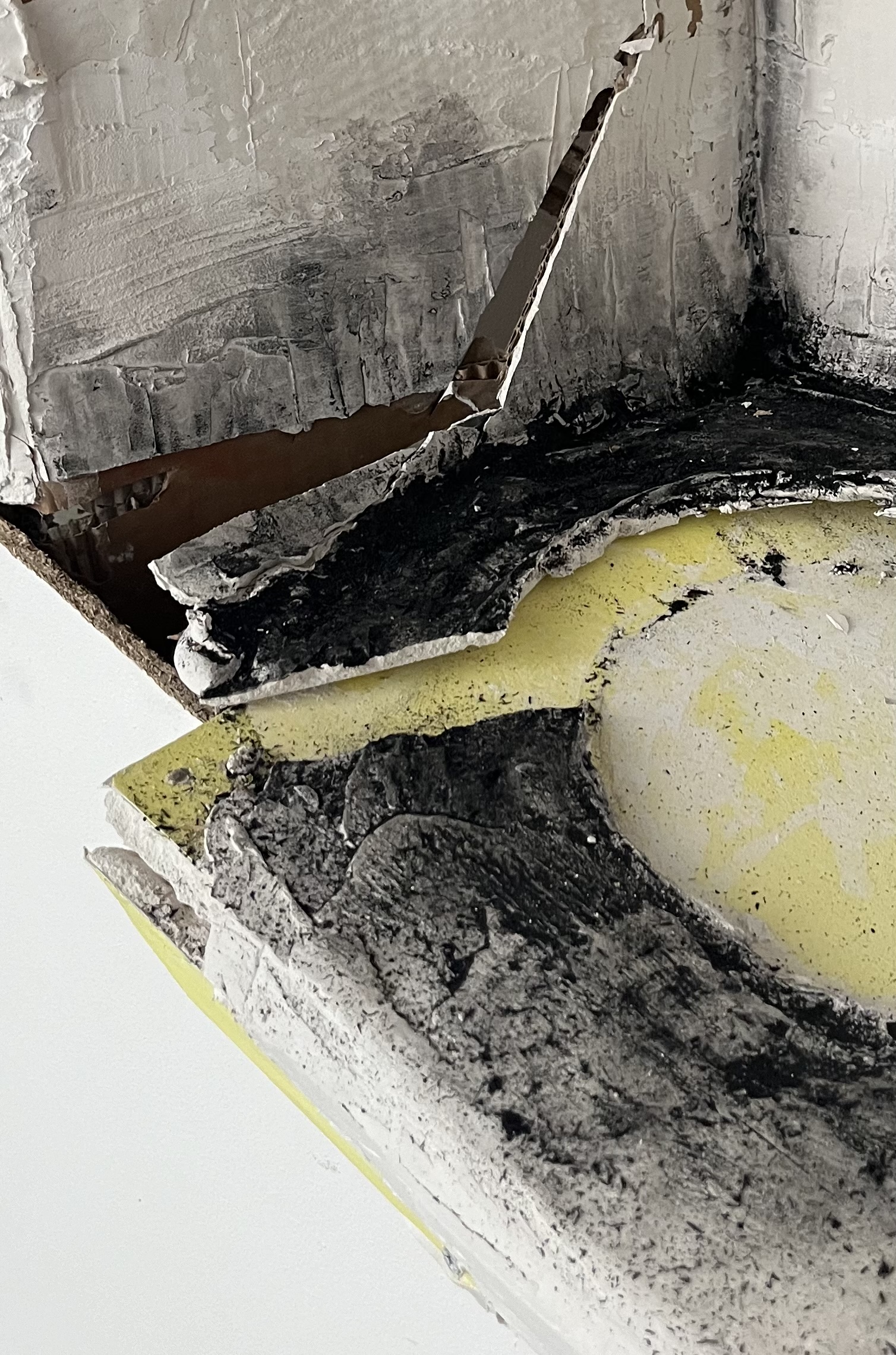
The wooden mock-up of a stove is made from scraps of packaging and construction timber left over from previous exhibitions at the Kunsthaus. In this way, the newly created work connects with the institution’s past and gives rise to a shared economy, an economic ‘we’. On both a material and a metaphorical level, the fireplace appears as a site of transformation: whatever is fed into it is converted into a different state. The title Kemenate Klosterthor also plays on elements of the past. Kemenate is the historical term for a heated living space with a stove, whilst Klosterthor takes its name from the railway station that was located in the vicinity of the building now housing the Kunsthaus until 1906. In this way, the work connects local urban history with the Kunsthaus foyer and evokes the image of a fireside room that once belonged to Klosterthor station.
The fireplace opening offers a view of a group of lime trees. Instead of the flames, the eye is drawn to nature. Meanwhile, the window next to the fireplace does not open outwards, but into another room. It depicts the parlour of an Austrian farming family in the painting Der Abschied des Conscribierten (engl. The Conscript’s Farewell) by Georg-Ferdinand Waldmüller, dated 1854. Only upon closer inspection do the elements of the installation, which initially seem familiar, reveal themselves to be deceptive. An exploration unfolds of personal memory, transience and the possibility of creating something new from the relics of the past. Through an illusory interplay, the artist transposes historical traces and traditional motifs into new contexts, allowing visitors to experience how collective memory and forgetting are shaped by present-day perspectives and decisions.
In the experimental and communicative exhibition format Whisper Down the Lane, the roles and functions of hosting and being hosted become fluid: in line with the eponymous children’s game, the exhibiting artists themselves choose the next person. With the project, the Kunsthaus transfers part of the curatorial responsibility to the artists themselves, with the aim of creating alternative institutional modes of access and rendering local network structures visible both in terms of personal ties and with regard to artistic approaches. So far, works by Jaewon Kim, Fritz Lehmann, Altay Tuz, Pia Pospischil, Luzia Cruz, Laurel Chokoago, Cho Ari and Carolina Lehan, Sanna Leone and, most recently, Sally Dalgaard have been on display as part of Whisper Down the Lane.
Kastania Waldmüller (b. 1996) studied at the HFBK Hamburg, DE, and at the École supérieure des Beaux-Arts de Paris, FR. Her work has been exhibited at venues including Galerie 21, Hamburg (2026), openhalle, Berlin (2026), Gruppe Motto, Hamburg (2025) and at Parallel Vienna, Vienna (2024, 2026), as well as at the Kunstverein in Hamburg (2021).